

Upasna Srivastava
PhD Scholar
20 min read
July 11, 2026
01. INTRODUCTION
The Bender-Gestalt II: A Complete Guide to One of Psychology's Most Enduring Assessment Tools
Imagine a child sitting at a table with a pencil in their hand, staring at a card with a single basic geometric figure on it. Their job? Write it down on a blank sheet of paper as accurately as you can. No trick questions, no ominous ticking of a timer in the background, just a shape, a pencil, and a piece of paper.
It sounds so simple it can't be important. And yet psychologists have been using tasks just like this, in one form or another, for almost ninety years now because how a person copies a shape turns out to say something surprisingly real about how their brain and body are working together. Welcome to the world of Bender Gestalt II.
02. History & Origin
A Test Nearly a Century in the Making
Every good story has a beginning, and this one begins in the late 1920s with a young neuropsychiatrist named Lauretta Bender, someone who, ironically, had her own struggles in school before becoming one of the most influential clinicians of her time.
It sounds so simple it can't be important. And yet psychologists have been using tasks just like this, in one form or another, for almost ninety years now because how a person copies a shape turns out to say something surprisingly real about how their brain and body are working together. Welcome to the world of Bender Gestalt II.
The Origin of the Bender-Gestalt Test
In 1938, the concept of "Gestalt," that people perceive wholes rather than parts, was widely discussed in psychology. Earlier, Max Wertheimer had made geometric designs to study perception. Psychiatrist Lauretta Bender adapted nine of these into the Visual-Motor Gestalt Test, stating that the way someone reproduces a design shows integrated functioning of the nervous system. She looked at children between the ages of 3 and 11 years and discovered a distinct progression in development, from scribbles to closed shapes and appropriate spatial relations by 6 or 7 years. Deviations from this trajectory can be indicative of developmental, learning or neurological problems.
Lauretta Bender: The Woman Behind the Test
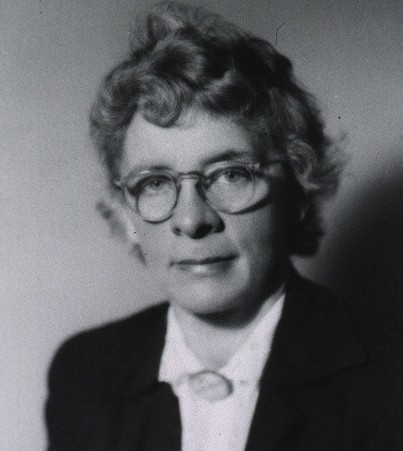
Lauretta Bender (Butte, Montana, 1897) surmounted early school difficulties to become valedictorian of her high school class. She studied biology and pathology before going to the University of Iowa medical school, where she trained with dyslexia researcher Samuel Orton, an influence in her interest in neurodevelopment and behaviour. While at Johns Hopkins, she began collecting data for the Visual-Motor Gestalt Test in 1929 and met psychiatrist Paul Schilder, her collaborator and partner.
She was the director of the Psychiatric Service at Bellevue Hospital (NYU) for over 20 years, contributed to the concept of childhood schizophrenia, trained many child psychiatrists, and kept improving her test.
Fun Fact
Lauretta Bender reportedly repeated first grade three times as a child — yet went on to graduate as valedictorian of her high school class and become only the second woman board-certified in psychiatry and neurology in U.S. history.
How Other Researchers Shaped the Test’s Legacy
Bender’s original test has inspired decades of follow-up research and adaptation by other leading psychologists, each bringing his or her own perspective:
- Max Hutt developed detailed administration procedures and scoring systems based on personality dynamics and psychopathology. He introduced concepts such as the “Psychopathology Scale” to include subtle behavioural signs during testing.
- Gerald Pascal and Barbara Suttell (1951) created a quantitative scoring system for distinguishing psychiatric patients from the general population, extending normative data to adults.
- A clever variation on the Background Interference Procedure (created by Arthur Canter) was to have the examinee redraw the designs on paper that had distracting lines in the background to detect subtle neurological impairment.
Elizabeth Koppitz
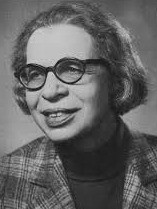
Elizabeth Koppitz was a trailblazer in learning disabilities and special education, authoring landmark works in psychoeducational assessment for children most notably The Bender Gestalt Test for Young Children (1964) and Psychological Evaluation of Children's Human Figure Drawings (1968) adapted the test specifically for children, developing the widely used Developmental Bender Scoring System along with a list of "emotional indicators" thought to reflect a child's psychological state.
To honor her lasting contributions, the American Psychological Foundation created the Elizabeth Munsterberg Koppitz Child Psychology Graduate Student Fellowship, which funds graduate research projects and scholarships in child psychology. (See more on child psychology here: https://www.all-about-psychology.com/child-psychology.html)
By the time scientists started work on a second edition, the original test had already received more than 1,300 citations in the American Psychological Association's PsycINFO database, securing its place as one of the most widely studied instruments in the history of psychological assessment.
Here's how the idea evolved:
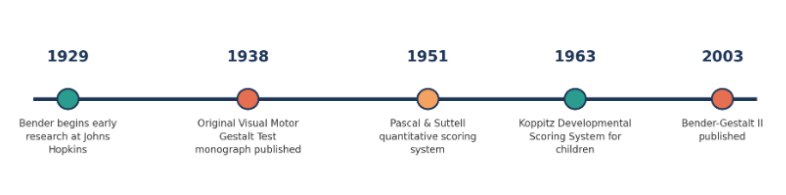
The original Bender-Gestalt was hampered by norms that only extended to age 10 and many scoring systems based on small, unrepresentative samples. Gary Brannigan and Scott Decker revised the test in the early 2000s, with three goals in mind: extending the test across the life span, creating a large nationally representative norm sample, and retaining the original nine designs and adding new items. Experts and pilots used a Rasch analysis to winnow 66 candidate figures down to a few that included easier items for young children and harder items for adolescents and adults.
03. WHAT IT MEASURES
So, What Is It Actually Measuring?
At its core, the test measures what psychologists call visual-motor integration a fancy term for the brain’s ability to see a pattern, then direct the hand to reproduce it accurately. That sounds like one skill, but it really is three working together:
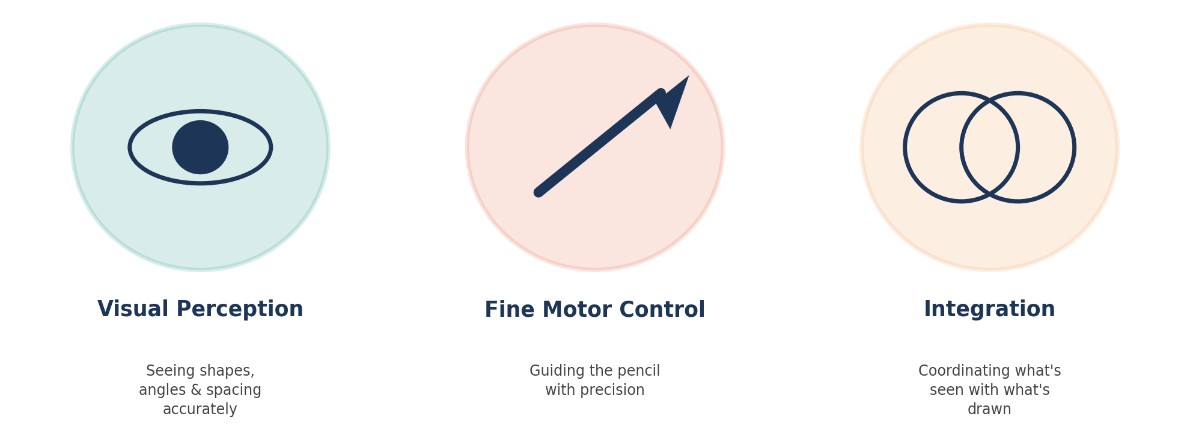
When these three processes are working properly, a person's drawings will tend to look very much like the original design. When one of them is disrupted by a developmental delay, a learning difficulty, a neurological condition, or age-related decline, the drawings often reveal it, sometimes before anyone can put their finger on exactly what’s going on.
04. Bender-Gestalt II
What’s New in the Bender-Gestalt II
The result, published in 2003, included all nine of Bender’s original designs, but added new ones, some used only with younger children, others reserved for individuals 8 years old and older, to expand the assessed age range from roughly 4 years old through 85 and beyond.
Some other meaningful additions accompanied the revision:
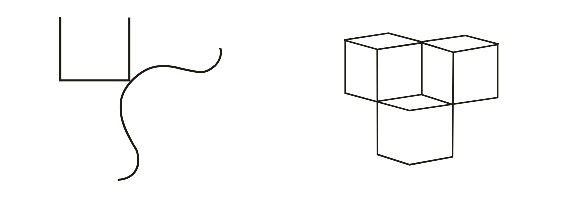
Step A: Recall : The test-takers are asked to copy the designs and then reproduce as many as possible from memory. This simple addition allows examiners to have a quick, informal look at visual memory, which may be particularly useful when evaluating older adults for memory-related concerns.
An Observation Form : The format offers examiners a consistent way to record behavioral observations (e.g., hesitation, impulsivity, too much erasing, difficulty with the task) that often matter just as much as the drawings.
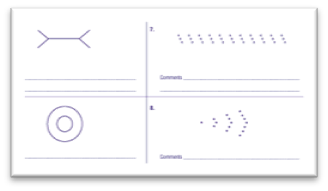
Supplemental Motor and Perception Tests : These short, simple screening activities can provide insight as to why someone may be struggling on the main test. If a person does poorly on the Copy phase, these additional tests will help determine if the problem is due to motor coordination difficulties, visual perception difficulties, or the more complex combination of the two.
A simplified Global Scoring System : The old scoring systems were really good. They were also very complicated and people had to learn a lot to use them correctly. The Global Scoring System is different it is simple and easy to understand so anyone can use it. It still gives very good results.
How a Testing Session Actually Unfolds
Without giving away any of the specific, protected test content (more on that below), here's the general shape of what an examinee experiences during a session:
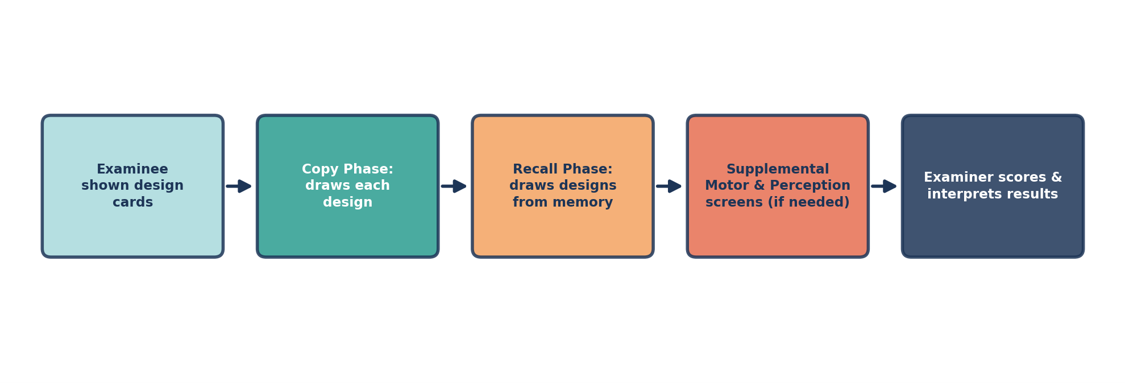
The whole process is really simple: no computers, no machines. Just cards, paper, a pencil, and a trained examiner who watches closely what the person draws and how they draw it. Does the person draw carefully? Take their time, or do they rush through it quickly? Do they erase a lot? Do they seem nervous about how well they are doing? The way the person behaves when they draw is often just as important as the drawings themselves. The examiner pays attention to the drawings and the person's behaviour, like the Art Therapy drawings, because the Art Therapy drawings and the person's behaviour can tell them a lot about the person
A Skill That Rises, Plateaus, and Gently Fades
The thing about visual-motor integration that really catches my attention is that it is not something that stays the same forever. Visual-motor integration actually changes a lot as we get older. It gets better and better when we are kids, and it keeps getting sharper as we become teenagers. When we are grown-ups, our visual-motor integration is pretty good. It does not change much. As people get older, their visual-motor integration often gets worse over time.
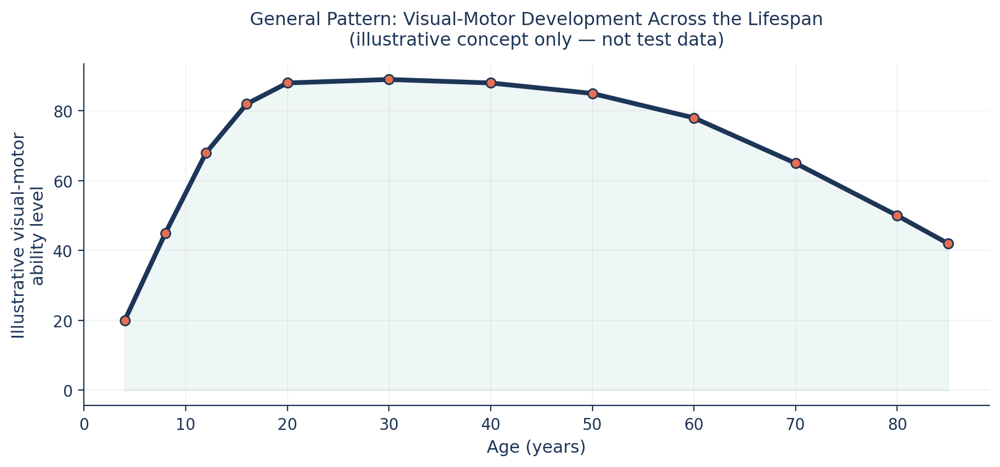
This is why they changed the modern Bender-Gestalt II test. The new test works for people of all ages, from kids to really old people like those in their nineties. The old test was not good for people over the age of 10. The modern Bender-Gestalt II test is different. The modern Bender-Gestalt II test is better because it can be used for the Bender-Gestalt II test with people of all ages, including the modern Bender-Gestalt II test for kids and the modern Bender-Gestalt II test for older people.
Did You Know?
The added “Recall” phase — where examinees try to redraw the designs from memory — has proven especially useful for older adults, since memory-related conditions often show up clearly here even when basic copying ability stays relatively intact.
Where Clinicians Actually Use It
The visual-motor integration test is something that affects a lot of skills like handwriting and learning in the classroom and being able to do things on our own. That is why the visual-motor integration test is used in different situations, including when we are trying to figure out if a child is ready for school or if they are having trouble learning.
The visual-motor integration test is also used when we are trying to understand if someone has a learning disability in reading, math, or writing.
Sometimes the visual-motor integration test is used to include:
- School readiness and early learning difficulties
- Specific learning disabilities in reading, math or writing
- ADHD and broader attention-related concerns
- Neuropsychological evaluation after injury or illness
- Memory and cognitive changes in older adulthood, including dementia screeningADHD and broader attention-related concerns
It is very important to remember that the visual-motor integration test is never used by itself to decide if someone has a problem. The visual-motor integration test is like one piece of a puzzle that a doctor uses to understand what is going on. The doctor also talks to people. Looks at their history and uses other tests to get a complete picture of what is happening with the visual-motor integration and other skills.
Why You Won't See the Actual Designs Here
You might have seen that this article talks about the test in a lot of detail. It does not show you the actual geometric designs that are used in the real test. This is on purpose. Most tests that are used to see how people think are like this. The special cards that are used for the test and the way the scores are figured out are kept private, not because people are trying to hide things. Seeing the real test questions before you take the test can make the test not work very well for people who take it later. It is like seeing the questions on a school test before you take it.
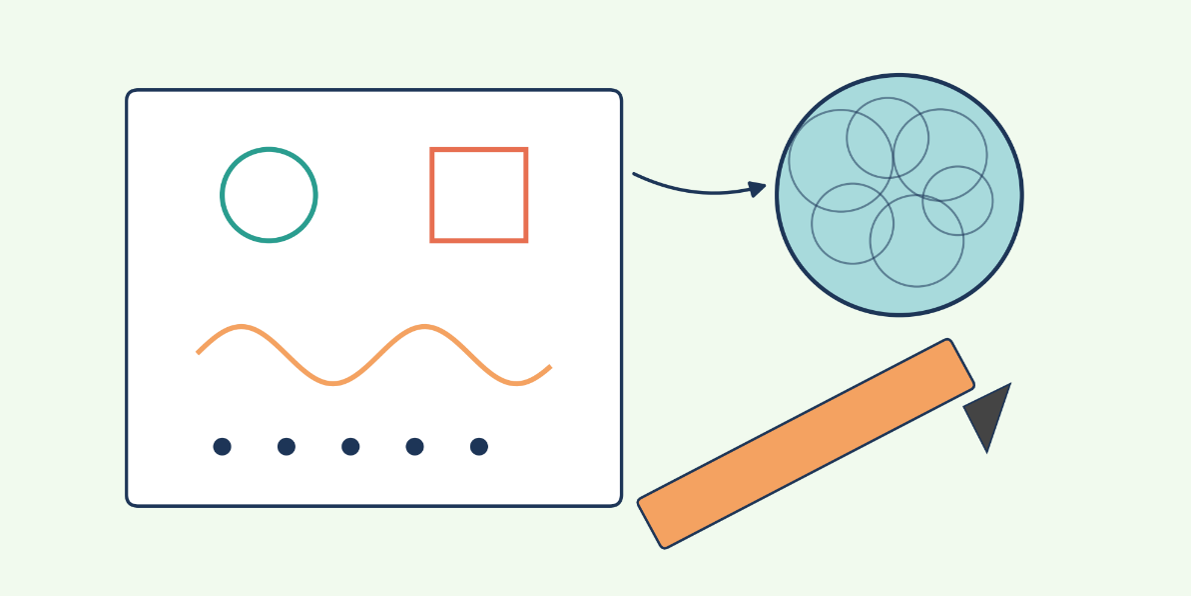
The pictures in this article are new. Are not, like the real test. They are just used to give you an idea of what a visual-motor copying task is like. They do not show any of the test questions, so that is okay. The geometric designs used in the test are not shown here because the real test needs to stay accurate for people who take it in the future, just like the geometric designs and the test itself.
05. Scientific Evidence
Reliability and Validity: Does the Bender-Gestalt II Hold Up?
Reliability :
- Strong interrater agreement, even with minimally experienced examiners, thanks to a simplified scoring system.
- Good internal consistency across most age groups.
- Stable test-retest reliability over short intervals.
Validity :
- Meaningful correlations with other visual-motor measures, supporting construct validity.
- Associations with academic achievement (especially math and reading) and with intelligence tests are stronger for nonverbal/performance than verbal scores.
- Factor analyses indicate the test primarily measures a single coherent visual-motor construct.

06. FAQ'S
Quick Answers to Common Questions
Is this an IQ test?
No—it measures visual-motor integration specifically, though scores do correlate with broader measures of intelligence.
How long does it take?
Typically, 10–20 minutes for the core phases, plus a few extra minutes for optional supplemental screens.
Who can give this test?
Only trained professionals, typically licensed psychologists, school psychologists, or neuropsychologists, should administer, score, and interpret it.
Can it diagnose something on its own?
No single test does that. It's always interpreted as one part of a broader evaluation.
What age range can take this test?
The current edition is normed for individuals from age 4 through 85 and older.
Can this test diagnose a learning disability or ADHD on its own?
No. The Bender-Gestalt II is one part of a comprehensive evaluation.
Is it used for older adults too?
Yes. The Recall phase is useful in evaluating memory concerns in older adults.

06. Buy It Now
The Takeaway
Ninety years ago, a young psychiatrist asked kids to draw simple shapes. Today, this basic idea, now refined and tested over time, still helps doctors understand how our minds and bodies work together. Simple tools can really last a long time.
If you or someone you know has to take this kind of test, keep in mind that it's one part of the process. A qualified psychologist will look at the results along with how the person acts, their personal history, and other test results to get a picture of who they are, not just based on one drawing.
Prasad Psycho, a leading publisher and distributor in India, stocks the Bender® Visual-Motor Gestalt Test, Second Edition (Bender-Gestalt II). This widely used, psychometrically sound instrument assists clinicians and researchers with visualmotor assessment and diagnostic evaluation. Obtain the authorized Bender- Gestalt II through Prasad Psycho for professional use.
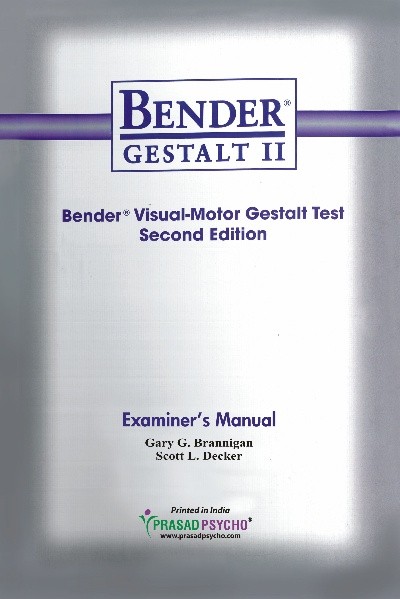
Bender Visual-Motor Gestalt Test - Second Edition (BGT - II)
Age Range : 4 Years – 85 + YearsThe Bender Visual-Motor Gestalt Test, Second Edition (Bender-Gestalt II) is abrief assessment of visual-motor integration that may provide interpretiveinformation about an individual's development and neuropsychologicalfunctioning. The Bender-Gestalt II is ideal for use as a first measure in anextended psychological battery. With its simple design and administration,the Bender-Gestalt II is an effective and non-threatening warm-up to morechallenging assessments. It is also a reliable tool to assess Visual-Motordevelopment and may be used as a screener for neuropsychological impairment.